Anxiety in Children Doesn’t Always Look Like Worry
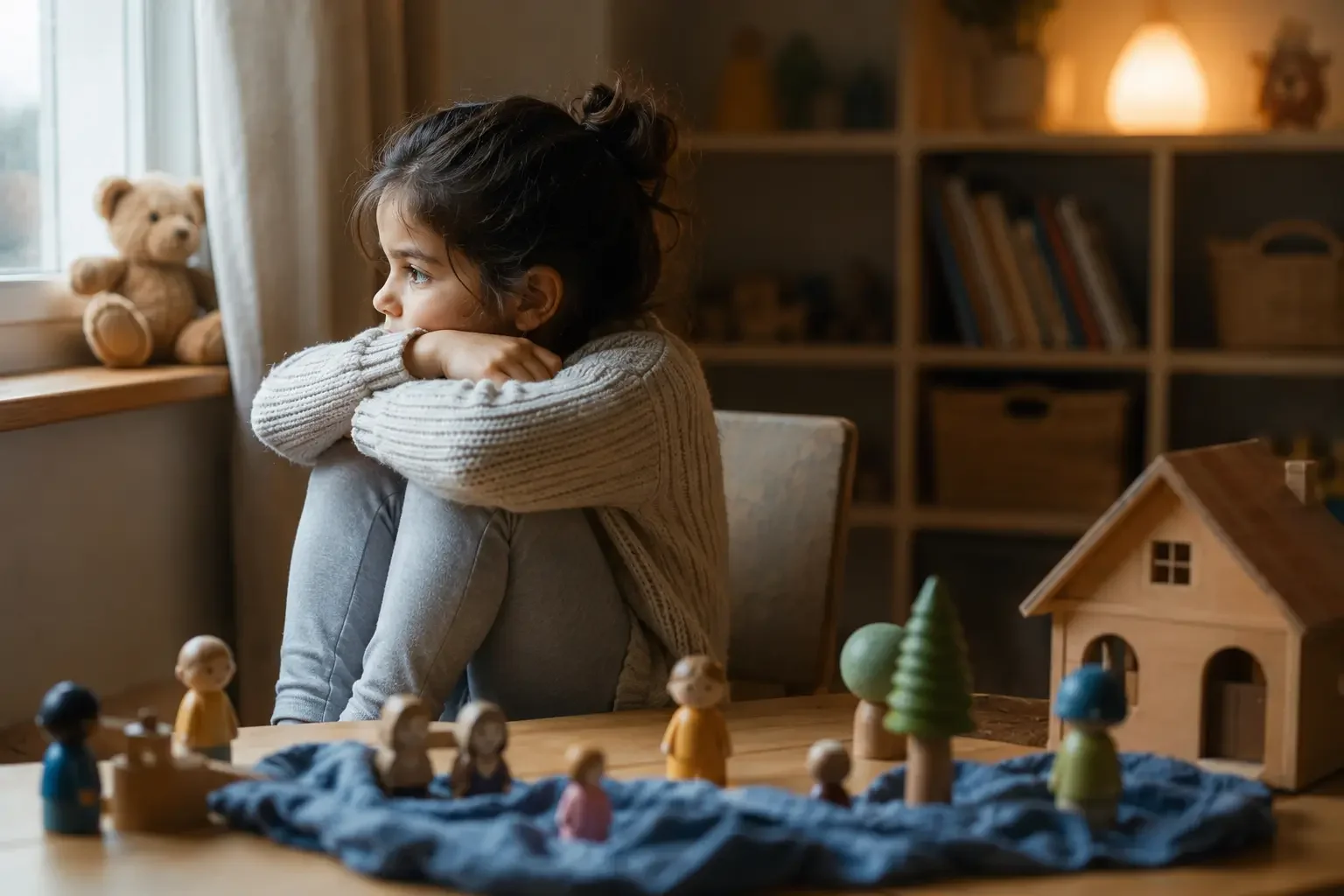
Anxiety in children does not always look the way adults expect it to.
Parents often describe something more confusing: a child who seems completely fine in some moments and then suddenly isn’t. Who complains of stomach aches on Sunday evenings. Who asks to stay home from school without being able to say why. Who falls apart over something small in a way that feels completely disproportionate. Some anxious children cry easily. Others become perfectionistic, redoing things until something internal is satisfied. Some become clingy in ways that feel regressive. Others go quiet, withdraw, and become very hard to reach.
Anxiety rarely announces itself clearly in children. More often it leaks out sideways - through the body, through behaviour, through avoidance, through the texture of ordinary daily life. A child may not say “I’m anxious.” They show it instead, in the only languages available to them.
Part of what makes this so difficult to recognise is that anxiety often exists in the nervous system before it exists in language. Adults can usually describe what makes them anxious, even when they can’t fully resolve it. Many anxious children genuinely can’t. They only know something inside feels unsafe, uncertain, or overwhelming - and even that much may not be fully conscious.
Why Direct Questions About Anxiety Often Go Nowhere
“Why are you worried?”
“I don’t know.”
“What are you scared of?”
“Nothing.”
“But something must be bothering you.”
Silence.
This isn’t evasion. The feeling often exists before the child has the capacity to organise it into words. Asking a child to verbalise something their nervous system hasn’t yet processed tends to produce shutdown or escalation rather than insight - which is why direct conversation alone is often insufficient for anxious children, and why the absence of words doesn’t mean the absence of experience.
Why Play Therapy Works Differently for Anxious Children
Children communicate through play in ways that both precede and exceed language. In the playroom, anxious children often reveal their inner world symbolically long before they can speak about it directly.
An anxious child may build carefully controlled environments where every figure has a precise place and any disturbance feels intolerable. They may create miniature worlds with strong perimeters and protected spaces - animals in containers, characters in hiding, structures that must not be altered. They may avoid spontaneity or surprise entirely, needing to know what will happen before they can engage with it. They may check in with the therapist repeatedly, needing the space confirmed as safe before they can fully inhabit it.
Over time, something gradual begins shifting. The child who needed every detail controlled starts tolerating a little more uncertainty. The play becomes looser, more spontaneous. Characters who remained hidden begin to emerge. Scenarios that revolved around danger begin including rescue, safety, and resolution. The child starts engaging with the unexpected without the nervous system flooding so quickly.
This shift doesn’t happen because the child was repeatedly told “you’re safe.” It happens because safety becomes something the nervous system repeatedly experiences inside a consistent relationship - until the body begins believing what words alone couldn’t convince it of.
Why Anxiety Often Looks Like Behaviour Problems
For many anxious children, the difficulty isn’t a lack of information about anxiety. The nervous system has learned to interpret ordinary uncertainty as threat. A social interaction, a change in routine, a perceived mistake, the anticipation of something unfamiliar - these can all register internally as danger signals, triggering the same physiological response that actual threat would produce. The body doesn’t distinguish. It just responds.
This is why anxiety in children so often appears behavioural from the outside - the refusal, the meltdown, the clinginess, the avoidance, the perfectionism, the rigidity. The behaviour is usually an attempt to create safety. Not manipulation, not wilful difficulty, not laziness. A protection strategy that has become overgeneralised.
Play Therapy works at this level - not only at the level of thoughts and emotions, but at the level of what the nervous system has learned to expect from the world. Safety is experienced before it’s understood. Regulation is practised inside a relationship before children can access it reliably on their own. For many children, that relational experience becomes the foundation from which genuine emotional flexibility gradually grows.
Anxiety can be exhausting for parents in a particular way - the constant negotiation around school, the unpredictability, the helplessness of watching a child suffer when the suffering seems disproportionate to what’s actually happening, the confusion about when to accommodate and when to gently push. These are genuinely hard questions without universally simple answers.
What tends to matter most is that children begin feeling less alone in what they’re carrying - that there is at least one relationship where their anxiety isn’t treated as a behaviour problem to be eliminated, but as a nervous system communicating overwhelm that needs understanding and support.
Anxiety in children doesn’t always look like worry. Sometimes it looks like a child trying very hard to hold everything together in the only ways they currently know how.
Anya Reddy is a Certified Synergetic Play Therapist and PCI Certified Parent Coach working with children and families in Bangalore and online. Her work focuses on emotional regulation, anxiety, nervous system-informed care, behavioural challenges, and helping children process experiences through play.